

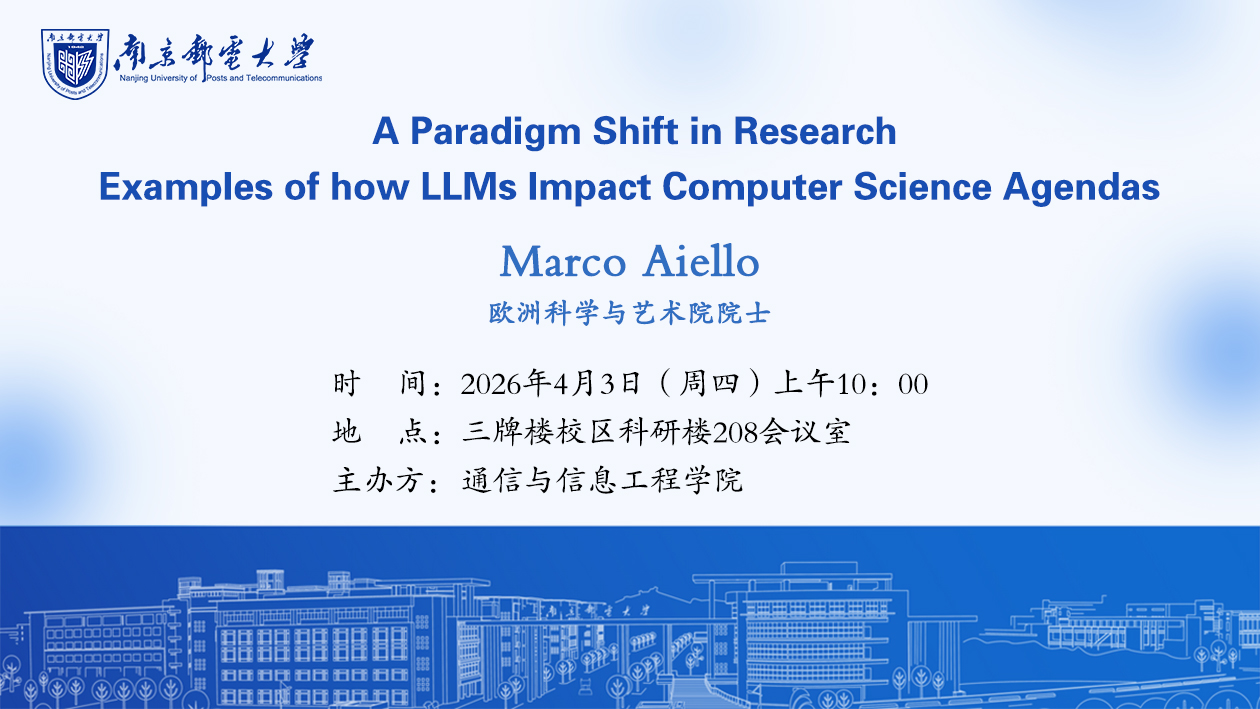
报告题目:A Paradigm Shift in Research: Examples of how LLMs Impact Computer Science Agendas
报告摘要:
Large Language Models (LLMs) have rapidly evolved from linguistic tools to general-purpose reasoning engines, triggering a paradigm shift across the field of computer science. Their influence extends far beyond natural language processing, reaching the core of disciplines traditionally grounded in formal models and symbolic reasoning. In this talk, I will explore how LLMs are reshaping research agendas I have been involved in. Through concrete examples, I will illustrate how LLMs can act as planners that generate and revise task sequences, as navigators capable of contextual awareness and adaptation, and as software co-engineers that understand and synthesize distributed systems. The talk will reflect on both the emerging opportunities and the open challenges in this fast-evolving research landscape.
报告人简介:
Marco Aiello,Professor of Computer Science, Head of the Service Computing Department, and Vice-Dean of Faculty V at the University of Stuttgart, Germany. An elected member of the European Academy of Sciences and Arts, Fellow of AAIA, Global Affiliated Research Faculty at Chang Gung University. He is vice-president of Informatics Europe. He is the Editor-in-Chief of IEEE Transactions on Service Computing and member of the Steering Committee of the ICSOC Conference serie. He holds a PhD in Logic from the University of Amsterdam, the Habilitation in Applied Informatics from TU Wien, and a master's degree in Engineering from La Sapienza University of Rome. In 2016, together with three former Ph.D. students, he founded the company SustainableBuildings BV, acquired in 2020 by the Dutch energy company Innova BV. His research interests are in Service Computing, Smart Energy Systems, and Spatial Reasoning. He has authored over 200 peer-reviewed articles and several books, which have been cited more than 9.000 times.

